
ZIANEW MEXICO / INDUSTRIAL VISIONDiscuss the $500K round
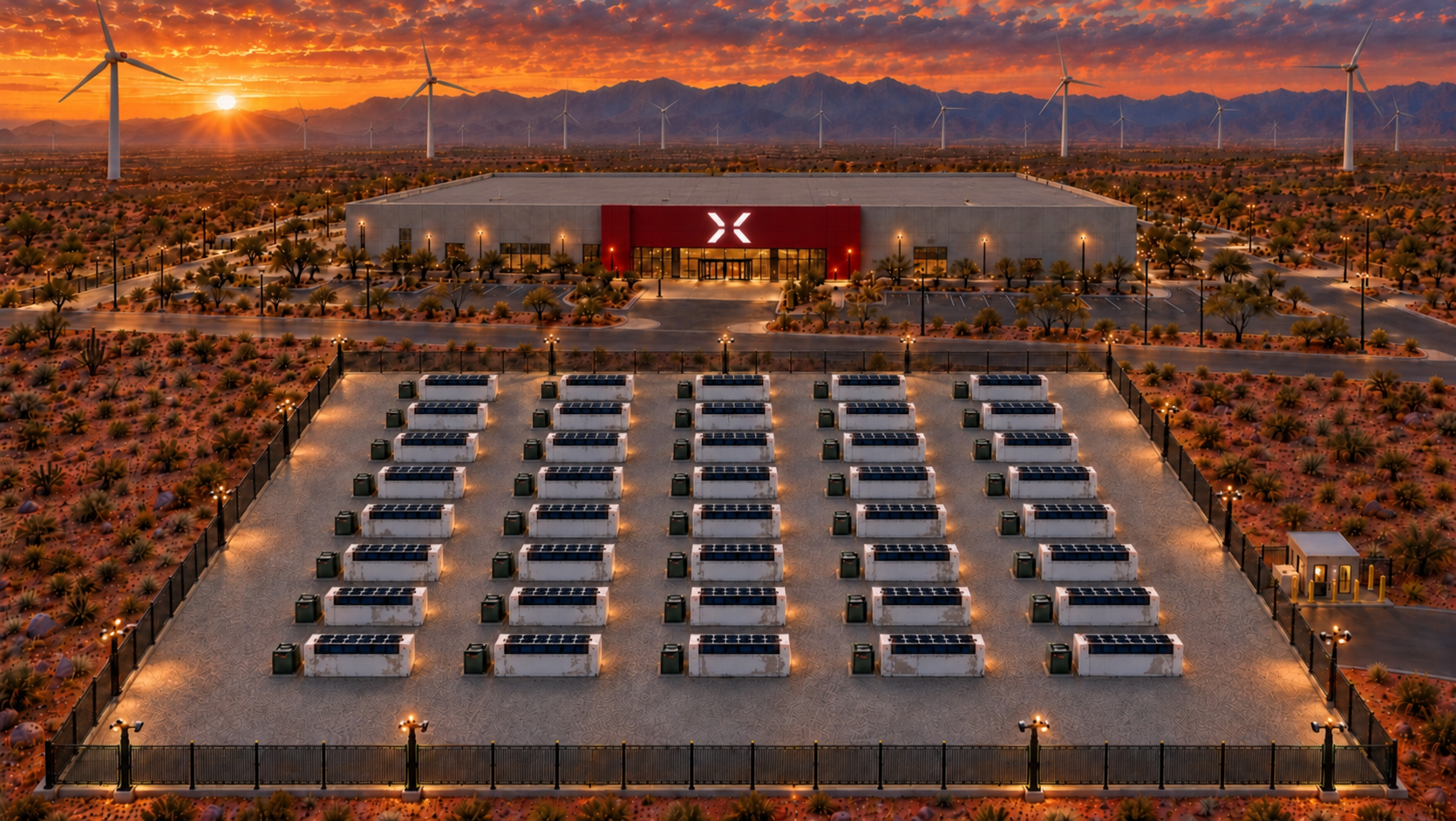
Concept rendering of a desert compute campus at sunset

NOW RAISING | $500,000 PRE-SEED

Smart vision.
Real ambition.
$500K pre-seed.

Help advance XR and AI-assisted smart vision. The $500,000 pre-seed round funds the technical, customer, site, and power diligence needed to prepare the next investment stage.

Discuss the $500K pre-seed roundSee the use of funds
ARTESIA REGION · NEW MEXICOCAMPUS CONCEPT · PROPOSED, NOT BUILT

THE OPPORTUNITY TODAY

$500,000.
The first conviction.

Pre-seed capital for the path to XR and AI-assisted smart vision.

Request a founder conversation

The immediate investment opportunity is the $500K pre-seed round. The seed, Series A, federal grant request, and potential IPO are later milestones.

Proposed use of the $500K

Optics, manufacturing process and IP diligence
$150K
Site, utility and mining feasibility
$125K
Customer validation and commercial planning
$75K
Financial, legal and grant-readiness work
$75K
Development reserve
$75K

Proposed allocation, subject to written scopes. Valuation, security, ownership, and investor rights will be negotiated. No funding is represented as committed.

What this round should deliver

A defined optical manufacturing scope and IP path, customer evidence, site and utility feasibility, a tested mining business case, and a documented capital plan for the $2M seed round.

THE PITCH / IN ONE MINUTE

The ultimate product:
XR + AI smart vision.

Start with the product. Build the infrastructure. Secure the power.

Zia’s ultimate product is XR and AI-assisted smart vision: wearable glasses designed to place digital information, spatial interfaces, and AI assistance into the wearer’s view. The proposed manufacturing plant would develop the waveguide wafers and display projector modules that enable that experience. Mining and AI compute bring a second infrastructure opportunity. Wind leads the energy strategy, with solar added only where it improves the numbers.

One owner’s initiatives. Three business cases. Phased investment with evidence at every step.

01 / ZIA MANUFACTURING

Build the optics.
Enable the vision.

A $500 million federal CHIPS Act grant request for a proposed U.S. waveguide and display manufacturing program.

The ultimate product is XR and AI-assisted smart vision. Waveguides direct an image toward the eye; projector modules create and inject it. Vision is intended to bring useful information, spatial computing, and AI assistance into everyday glasses. These are development goals, not validated production capabilities.

The first manufacturing milestone is a repeatable pilot process: define the substrate, optical patterning, coatings, projector assembly, alignment, and testing. Prove image quality, yield, and unit cost before committing to a full production line.

CHIPS starting point

Document exactly what the plant makes. Optical glass waveguides and assembly of purchased display chips do not establish semiconductor-facility eligibility. Semiconductor fabrication, packaging, or qualifying supply-chain production must be evaluated on their actual process.

Visit ZiaTeam.com
Zia Vision glasses product visualization
ZIA VISION · PRODUCT VISUALIZATION, NOT A FACTORY PHOTOGRAPH

THE PRODUCT BEHIND THE PLANT

See what Zia is working toward.

Concept film from ziateam.com

A vision of the intended experience. Product targets and manufacturing processes remain subject to engineering validation.

02 / MINING + AI COMPUTE

Infrastructure that
grows by proof.

The proposed campus combines mining and AI facilities. NMMINE provides the regional service story: site review, hardware sourcing, installation coordination, monitoring, and maintenance.

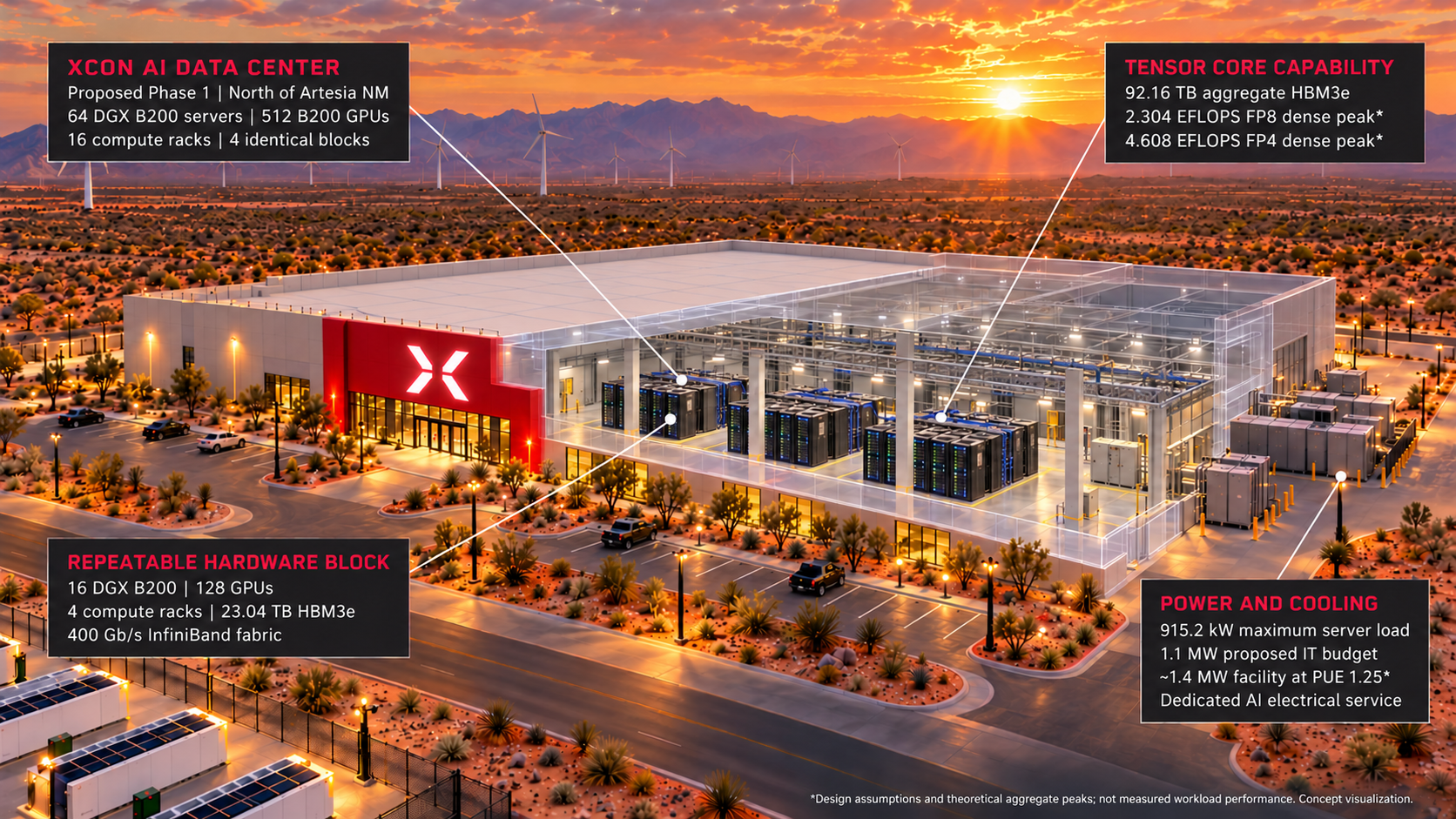
Proposed AI compute hall concept cutaway
CAMPUS DESIGN CONCEPT · EQUIPMENT AND LOADS REQUIRE ENGINEERING CONFIRMATION
40Proposed mining installations
64Proposed DGX B200 servers
~45.4 MWCampus planning load*

*Campus source concept: 44 MW mining + approximately 1.4 MW AI, before shared ancillary loads and upstream losses. Excludes the proposed Zia plant. No utility capacity is represented as secured.

Keep critical loads dependable.

Manufacturing and contracted AI services need their own reliability design. Mining can be evaluated as a controllable load, with separate meters, protection, and utility-approved curtailment.

Start with a small tranche.

Validate land, utility capacity, fiber, cooling, permits, and customers. Commission a limited mining deployment and one AI block before repeating the design. Finance expansion against measured economics.

03 / ENERGY INITIATIVE

Wind first.
Solar where it helps.

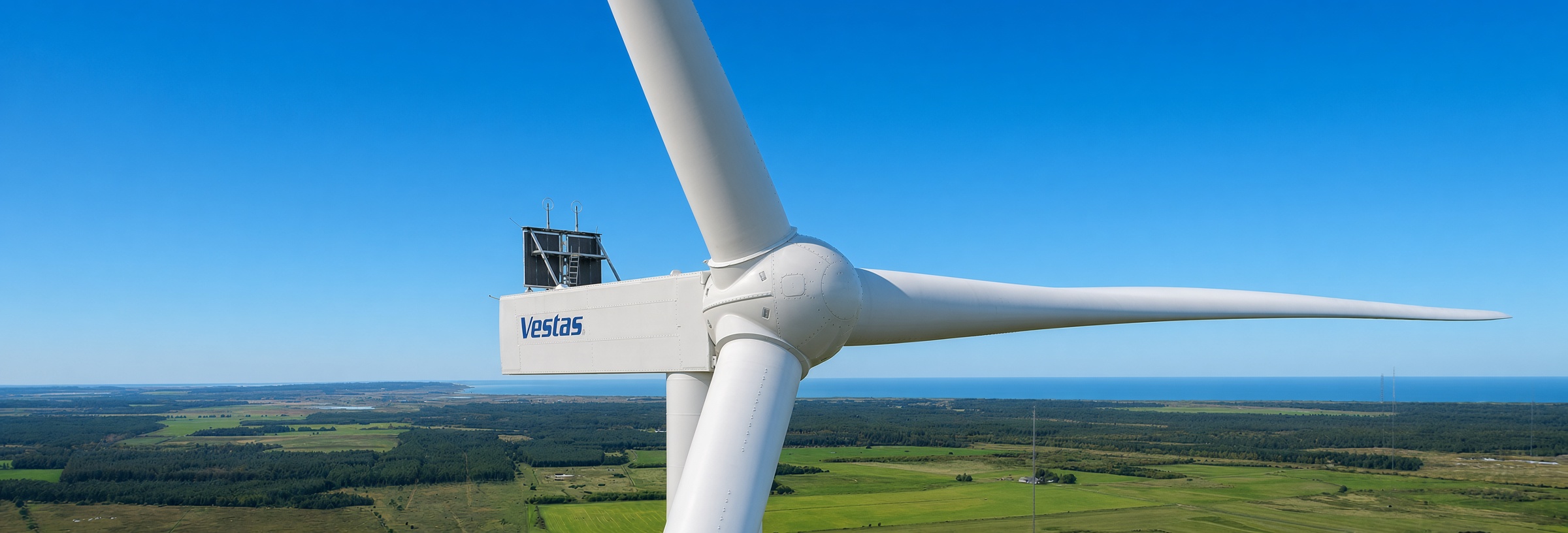
Wind turbine reference photograph
WIND REFERENCE IMAGE · DOES NOT DEPICT A SECURED PROJECT OR A NEW MEXICO SITE

Buy reliable power first. Develop the right renewable supply alongside it.

Compare a wind power purchase agreement with ownership or a development partnership. Study the wind resource, land, transmission, interconnection, and delivered price. Add solar only if the hourly generation mix, land use, and economics support it.

Wind output varies. Annual energy matching is different from dependable power every hour. Grid supply, firming contracts, and any justified storage must protect the plant and AI commitments.

ILLUSTRATIVE CAMPUS ENERGY MATCH19 turbines × 6.2 MW × 40% ≈ 47.1 MW average

This reproduces the approximate wind scenario for its ~45.4 MW campus concept. It is not a turbine order, site design, or continuous power supply. Zia’s plant load must be added after process design. Storage sizing needs hourly modeling.

THE CHIPS ACT STRATEGY

Federal manufacturing.
Private infrastructure.

Requested federal funding: $500 million through the CHIPS Act for Zia manufacturing. Mining, AI facilities, and energy retain separate financing plans. This is a proposed request—not an awarded grant or confirmed eligibility determination.

Immediate decision · November 1, 2026

NIST currently lists this deadline for semiconductor materials and manufacturing equipment concept plans. Confirm the portal cutoff and actual eligibility immediately. The $500M federal grant request must fit an applicable program; this pitch is a development proposal, not a submitted application.

Read the current NIST notice
InitiativeCapital strategyEvidence needed
Zia plant
Potential CHIPS anchor
Seek a $500M federal CHIPS Act manufacturing grant, subject to an applicable funding opportunity, eligible scope, agency review, and award terms. Determine required private capital separately; review §48D independently.Process flow, semiconductor nexus, IP rights, pilot results, customer demand, costed facility plan.
Mining + AI
Commercial infrastructure
Private equity, asset finance, and customer-backed capacity. No CHIPS grant assumed for mining or ordinary data-center operations.Firm power offer, hardware quotes, cooling design, fiber, customer contracts, downside operating model.
Wind + optional solar
Energy infrastructure
PPA or separate project finance. Evaluate current energy incentives and eligibility independently.Resource study, land rights, interconnection, hourly production, offtake, delivered cost, firming plan.
What makes the Zia application credible?
1. Prove the technical fit

Separate passive optical waveguide manufacture, semiconductor devices, purchased microdisplays, and projector assembly. Identify the precise eligible output and applicable funding opportunity.

2. Prove the need and demand

Document the U.S. supply gap, actual customers, letters of intent, technology rights, and why incentives change the size, timing, or feasibility of the investment.

3. Prove the project can execute

Provide a site strategy, vendor quotes, permits, water and utility requirements, schedule, pilot yield targets, and a team with manufacturing delivery experience.

4. Prove the capital and workforce

Prepare sources and uses, cash flows, funding gap, owner contribution, and downside cases. Obtain the required state / local incentive offer and education / training commitments for the applicable program.

What about the manufacturing tax credit?

IRS guidance lists a 35% §48D credit for qualifying investment placed in service after 2025, with construction required to begin before 2027. Eligibility is narrower than simply making technology: the facility’s primary purpose and qualifying property must satisfy the rules. Do not include the credit in committed funding until the actual Zia process and construction timing are reviewed. IRS Form 3468 instructions

How should shared ownership and costs be handled?

Present the initiatives as commonly owned, as the owner has stated. Confirm the legal entities and ownership records before submitting. Maintain project-specific budgets and track shared land, utility, personnel, and infrastructure costs with a documented allocation method. Avoid double counting the same eligible cost across incentives. An integrated pitch does not imply that one grant can fund the entire platform.

INVESTMENT FRAMEWORK / SINGLE-NUMBER ESTIMATES

A starting budget.
A disciplined first ask.

$1.05 billion indicative project program.

Project framework: $500M Zia manufacturing grant request + $300M mining / AI planning budget + $250M wind allowance. Financing rounds below are funding sources and milestones, not additional project costs. The capital plan assumes an owned wind project; a PPA would change it.

01 / FEDERAL CHIPS GRANT REQUEST$500M

Requested from the U.S. federal government for the proposed Zia waveguide / display manufacturing program supporting XR and AI-assisted smart vision. Exact chip fabrication versus purchased-chip assembly scope requires engineering and eligibility review.

Estimate basis

Owner-directed $500M funding request, not a validated factory estimate. Develop a bottom-up budget for facilities, equipment, technology rights, pilot qualification, startup, and contingency. The request does not establish that the government will fund the entire project.

02 / MINING + AI CAMPUS$300M

Owner-confirmed $300 million planning budget for the source concept’s 40 mining installations and 64-server AI facility. Detailed allocations remain illustrative until engineering and vendor validation.

Estimate basis

Mining hardware / containers / cooling $110M; AI servers / network / storage $55M; site / buildings / electrical / utility work $60M; commissioning / startup $15M; contingency $60M. Hardware configuration and utility scope remain unpriced assumptions.

03 / WIND DEVELOPMENT$250M

Illustrative 117.8 MW nameplate wind project: 19 reference turbines at 6.2 MW each. Sized to the campus energy example, excluding the as-yet-undefined plant load.

Estimate basis

Turbines and installed balance of plant $190M; land / development / interconnection allowance $20M; contingency $40M. Implied all-in allowance: approximately $2,122/kW. Excludes battery storage and ongoing grid / firming costs.

The $500M CHIPS request and $300M mining / AI planning budget are owner-directed. Mining cost allocations and the $250M wind estimate are illustrative assumptions in U.S. dollars, prepared October 29, 2026. They include stated contingencies and startup allowances; exclude financing costs, ongoing operations, optional solar, storage, and major offsite grid upgrades beyond the allowance. A semiconductor fabrication scope would require a fresh manufacturing estimate. No tax credits or CHIPS awards are deducted.

THE FIRST CAPITAL$500K

Pre-seed ask, followed by a $2M seed ask. Combined early capital: $2.5M.

Prove the route to smart vision.

Use early capital for manufacturing process and IP diligence, customer development, site / utility feasibility, mining economics, and the applicable CHIPS submission. Round-specific budgets and investment terms will be negotiated.

Proposed liquidity route: a mining-facility sale or refinancing, after operating performance, debt obligations, transaction costs, and legal restrictions are satisfied. No investor repayment or valuation is guaranteed.

A PRACTICAL DEVELOPMENT PLAN

Start small.
Earn the next phase.

Proposed work windows after authorization. Construction timing follows feasibility, permits, financing, and utility commitments.

NOW / FUNDING TRIAGE

Confirm the fit.

Resolve Zia’s manufacturing process and program eligibility. Check the November 1 deadline. Name the applicant, project lead, site options, and owner contribution.

Gate: a supportable funding route.
DAYS 1–30 / DEFINE

Build the evidence.

Collect IP records, process maps, customer interest, vendor estimates, and ownership documents. Request utility feasibility and state / local incentive discussions.

Gate: a scoped, costed concept.
DAYS 31–60 / VALIDATE

Test the economics.

Set pilot quality and yield targets. Model each business independently. Compare wind PPA and ownership; test optional solar and firming with hourly loads.

Gate: credible costs and demand.
DAYS 61–90 / DECIDE

Fund the first phase.

Select the pilot scope, negotiate customer and power terms, complete the diligence budget, and prepare an investment decision. Submit only to confirmed open, applicable programs.

Gate: financeable pilot scope.

PRE-SEED IS THE PRIORITY

Back the $500K round.
Build the evidence.

Seek $500K pre-seed, then $2M seed, to validate the manufacturing, mining, power, and federal funding pathways. Allocate proceeds against written scopes and milestones.

Proposed early capital: $2.5 million in two rounds. Funding rounds finance project costs; they are not added again to the project program. Investor liquidity terms require definitive agreements.

Download the working plan

CAPITAL ROADMAP / OWNER-PROPOSED STRATEGY

Build the asset.
Finance the vision.

Mining is the proposed early liquidity engine. XR and AI-assisted smart vision is the long-term product.

StageAsk / triggerPurpose and proposed liquidity
Pre-seed$500KValidate IP, technical scope, customer demand, site and power options, and mining economics. Negotiate participation in a future mining transaction as a potential liquidity route.
Seed$2MComplete engineering and commercial diligence, develop the pilot / campus financing package, and prepare applicable grant materials. Proposed exit through net proceeds of a mining-facility sale or refinancing.
Series A$300M–$500MProposed private financing envelope led by mining / AI infrastructure. The $300M campus budget remains the baseline; any excess requires an approved use-of-funds plan. A mining sale or refinancing may provide an exit for eligible early and Series A investors.
Federal CHIPS grant$500M requestedManufacturing funding sought from the U.S. federal government. On a formal award, begin IPO readiness work, subject to award terms, corporate structure, and independent assessment. Grant proceeds fund only authorized project uses.
Series B, if neededAmount to be determinedOptional bridge toward an IPO after manufacturing milestones and market review. Proposed investor liquidity is an eventual public-market transaction, subject to registration, listing, lockups, and actual trading liquidity.
How the mining exit would work
1. Establish the investment structure

Document which entity owns the mining assets and what rights each investor receives. A facility held in a separate company cannot automatically repay investors in Zia; use legally documented ownership and distribution rights.

2. Build transaction value

Secure power and permits, commission equipment, establish independently reviewable operating results, and maintain an asset register. Seek buyer or lender indications before treating the facility as an exit source.

3. Calculate distributable proceeds

Model transaction proceeds less senior debt, liens, fees, taxes, required reserves, and contractual restrictions. Refinancing creates new debt, not operating profit, and may leave no distributable cash.

4. Apply the agreed waterfall

Any redemption, buyback, or distribution follows investor agreements, solvency requirements, and applicable law. A partial mining sale must preserve access and power arrangements needed by the retained AI and manufacturing operations.

IPO readiness after a CHIPS award

A formal award would trigger evaluation of audited financials, public-company governance, reporting controls, grant compliance, corporate restructuring, and engagement with securities counsel and potential underwriters. Operating performance, market conditions, SEC requirements, and exchange criteria determine whether and when to proceed. A CHIPS award is not government endorsement of an investment, listing approval, or an investor exit.

Proposed financing and exit framework only. No investor return, redemption date, mining sale price, refinancing availability, grant award, or IPO is promised. Federal grant proceeds are not budgeted for investor cash-outs; related-party and shared-cost arrangements require review under award terms.

WHAT NEW MEXICO GAINS

Build capability.
Keep opportunity local.

Develop paid training pathways for optical technicians, electrical and mechanical trades, controls, networking, and facility operations. Invite regional colleges and workforce organizations to shape the program.

Publish measurable commitments after feasibility: local hiring, wages, training completions, supplier spend, water and energy use. Community benefits should be budgeted and tracked.

JON CARAVEO / FOUNDER

Jon Caraveo.
Founder.

“I’m building toward XR and AI-assisted smart vision through Zia, with mining infrastructure and regional expertise through NMMINE. I’m seeking $500,000 in pre-seed backing to validate the next stage.”

Founder and owner. Seeking pre-seed investors and strategic partners.

PRE-SEED INVESTOR CONTACT(575) 231-6564 caraveo@me.com

Artesia region, New Mexico
Direct contact confirmed by Jon Caraveo.

Discuss the $500K pre-seed round
Sources, project status & open decisions

Working proposal · reviewed October 29, 2026. The manufacturing plant is the owner’s proposed scope. Campus figures are source-site design assumptions. Imagery includes product and campus concepts; the wind photograph is a reference. No funding award, operating campus, customer agreement, equipment order, power commitment, or manufacturing qualification is claimed.

Decisions to confirm: plant site; glass vs semiconductor waveguide process; projector manufacturing scope; IP ownership; customer traction; available capital; utility status; wind land / PPA options.